Vishrut Kinikar
In the previous article I had covered some eye-opening scientific discoveries made by our ancient Indian scientists. This is a Part 2 of that article which sheds light on a few other scientific geniuses of ancient India.
Rishi Agatsya
We have all heard of Rishi Agastya but we have only thought of him as just one out of an innumerable number of Rishis in our Vedic pantheon. However, the work he has done and his incredible research is like none other. Rishi Agatsya was an exceptional engineer who gave the process for electricity generation, construction of batteries, and described electrolysis (splitting of water into hydrogen and oxygen with electrical current). It is believed that Italian scientist named Alessandro Volta was the first to invent the electric cell, but the process for constructing an electric cell was given by Rishi Agastya thousands of years before in his Agastya Samhita. The Agastya Samhita is a text which records the conversation between Rishi Agastya and his student Sutikshna, similar to the way the Bhagavad Gita is the conversation between Arjun and Lord Krishna.
In the Agastya Samhita, Rishi Agastya writes:
संस्थाप्य मृण्मये पात्रे ताम्रपत्रं सुसंस्कृतम्।
छादयेच्छिखिग्रीवेन चार्दाभि: काष्ठापांसुभि:॥
दस्तालोष्टो निधात्वय: पारदाच्छादितस्तत:।
संयोगाज्जायते तेजो मित्रावरुणसंज्ञितम्॥”
This translates to “Take an earthenware, put the copper sheet in it. Cover it first with copper sulfate and then by moist sawdust. After that, put a mercury-amalgamated zinc sheet on top of the sawdust to avoid polarization. The contact will produce an energy known by the twin name of Mitra-Varuna. Water will be divided by this current into oxygen and hydrogen. A chain of 100 containers is said to give an extremely powerful force. ”
In this shloka, “ताम्रपत्रं” refers to “copper sheet”, “शिखिग्रीवा” refers to “copper sulfate”, “दस्तलोष्ट” refers to “zinc”, “प्राणवायु” refers to oxygen, and “उदान वायु” refers to hydrogen. Mitra and Varuna are deities who are twin brothers. Varuna is the god of water, while Mitra is his twin counterpart. They are part of a group of twelve brothers known as the twelve Adityas (sons of Goddess Aditi and Rishi Kashyapa) However, in this context, Mitra and Varuna refers to something very different. Mitra refers to the cathode of an electric cell, and Varuna refers to the anode of an electric cell. Electricity is collectively referred to as “Mitra-Varuna-Samgnyitam”.
What is remarkable is the fact that Alessandro Volta used almost exactly the same materials as Rishi Agastya. He used copper and zinc like Rishi Agastya, but made use of cloth dipped in salt water instead of copper sulfate.
He additionally writes “अनने जलभंगोस्ति प्राणोदानेषु वायुषु। एवं शतानां कुंभानांसंयोगकार्यकृत्स्मृत:॥”
This translates to “If you use the power of hundred Kumbhas on water, and then the water will change its form into Oxygen and Hydrogen.” This shloka describes electrolysis, the process of using an electric current to split water into individual hydrogen and oxygen. The above shloka also uses the word Kumbha, which is the Sanskrit word for battery. In fact, Rishi Agastya is referred to in countless mantras and scriptures as “Kumbhodbhava”, meaning “the creator of the Kumbha”.
Along with being a brilliant electrical engineer, Rishi Agastya had an acute understanding of gaseous elements. It is said that balloons were invented by Michael Faraday for the purpose of conducting experiments, but balloons were described millennia earlier in the Shilpa Sutra of the Agastya Samhita in the shloka ” वायुबन्धकवस्त्रेण निबद्धो यानमस्तके उदान: स्वलधुत्वे बिभर्त्याकाशयानकम।” which means “If hydrogen is contained in an air tight cloth, it will fly in the air.”
Rishi Valmiki
Rishi Valmiki is one of the most famous Rishis in the Vedic pantheon, and he is most well-known for being the first biographer of Lord Rama’s life. Valmiki’s literary prowess is celebrated far and wide, to which the success of the Ramayana is a testament. However, the deep and penetrative understanding of base-ten mathematics by Rishi Valmiki, which he has also described in the Ramayana, is not well-known.
Rishi Valmiki has given the Sanskrit names of enormous powers of ten in Ramayana 6-28-33. The Ramayana has a mathematical side which is unmatched by any other ancient biographical account.
The Sanskrit word for ten thousand according to Rishi Valmiki’s numerical system is “Ayuta” or, written in Devanagari, “अयुत”. The word for one lakh in Sanskrit is “laksha” or “लक्ष”. The word for one million in Rishi Valmiki’s system is “niyuta” or “नियुत” and the word for ten million in Sanskrit is “koti” which is a word used even today in Indian languages.
The words for larger powers of ten in Rishi Valmiki’s system are given in the table below:
| English Name: | Description of number: | Exponent Representation: | Sanskrit Name: | Sanskrit Name in English Transliteration: |
| Trillion | One followed by twelve zeroes. | 1012 | शङ्कु | Shanku |
| Hundred quadrillion | One followed by seventeen zeroes. | 1017 | महाशङ्कु | Mahashanku |
| Ten sextillion | One followed by twenty-two zeroes. | 1022 | वृन्द | Vrinda |
| Octillion | One followed by twenty-seven zeroes. | 1027 | महावृन्द | Mahavrinda |
| Hundred nonillion | One followed by thirty-two zeroes. | 1032 | पद्म | Padma |
| Ten undecillion | One followed by thirty-seven zeroes. | 1037 | महापद्म | Mahapadma |
| Tredecillion | One followed by forty-two zeroes. | 1042 | खर्व | Kharva |
| Hundred quattuordecillion | One followed by forty-seven zeroes. | 1047 | महाखर्व | Mahakharva |
| Ten sexdecillion | One followed by fifty-two zeroes. | 1052 | समुद्र | Samudra |
| Octodecillion | One followed by fifty-seven zeroes. | 1057 | ओघ | Ogha |
| Hundred novemdecillion | One followed by sixty-two zeroes. | 1062 | माहौघ | Mahaugha |
The deep and penetrative understanding of geometry and spherical astronomy possessed by ancient Indians is fascinating, however the extent to which they could develop rather rudimentary concepts, such as the base-ten system, is equally noteworthy.
Rishi Sushruta
The foundation of Ayurvedic medicine is believed to be the Sushruta Samhita, a compilation of descriptions of medical procedures written by Sushruta. The science of surgery in ancient Bharat was known as “Shalya Tantra”, and the practice of Shalya Tantra is far more ancient than Sushruta himself. Before Sushruta, the face of Indian surgical science comprised of not one, but two people. These two surgeons were the Ashwini Kumaras, two horse-faced twins who are believed to have been the doctors of the gods. The Ashwini Kumaras (referred to as Dev Vaidya in the Rigveda) were recorded to have performed astounding surgical feats in their careers such as reattaching the head of Rishi Chyavana after he had been decapitated by Daksha, and attaching the head of a horse to Rishi Dadhichi. Another quite interesting account of the penetrating scientific acumen of the Ashwini Kumaras is found in one of the chapters of the Rigveda, where the story of the valorous queen Vishpala, the wife of King Khela is told. According to the Rigveda, Queen Vishpala had her leg severed off in a battle, after which the Ashwini Kumaras attached to her a prosthetic leg made of metal. This is the most ancient reference to a prosthetic limb ever made in the world which Indian history had lamentably forgotten. The good news, however, is that the story of Indian surgical science does not end here, but finds new vigor in the writings of Sushruta.
Sushruta in his Sushruta Samhita, describes eight methods of surgery known as the Ashtavidha Shastra Karma which are Chhedana (excision), Bhedana (incision), Lekhana (scraping), Vyadhana (puncturing), Visravana (drainage), Eshana (probing), Aharana (extraction), Seevana (suturing).
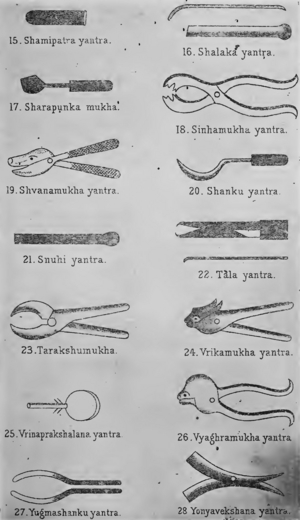
In addition to these eight methods, Sushruta elucidates 60 upakarma for the treatment of wounds along with the descriptions of 120 distinct surgical instruments and 300 surgical procedures! Sushruta even used doses of wine and henbane as anesthesia whilst performing on patients.
Sushruta also performed various types of plastic surgery including Nasa Sandhan (rhinoplasty), Oshtha Sandhan (lobuloplasty), and Karna Sandhan (otoplasty).
In addition to these procedures, Sushruta devoted a great deal of time to the study of ophthalmology and developed a procedure of cataract removal. The procedure is given below in English translation:
‘…This procedure is auspiciously performed primarily in the warm season… [Preoperatively] the skin is rubbed with a pledget of cotton saturated with an oily medicine followed by a heated bath. The patient is given a light refreshment. The sick room is fumigated with vapors of white mustard, bdellium, nimva leaves, and the resinous gums of shala trees (in order to rid the area of insects and the diseases they harbor)… Incense of cannabis is used in addition to wine for sedation… [Technique] The patient sits on a high stool with the surgeon facing him. The hands are secured with proper fastenings. The patient is asked to look at his own nose while the surgeon rests his little finger on the (bony margin of the outer angle of the orbit), holding a Yava Vaktra Salaka between his thumb, index, and middle fingers. The left eye should be pierced with the right hand, and vice versa. The eye is entered at the junction of the medial and lateral two-thirds of the outer portion of the sclera. If a sound is produced following the gushing of a watery fluid, the needle is in the correct place, but if the puncture is followed by bleeding, the needle is misplaced. The eye is then sprinkled with breast milk. Care is taken to avoid blood vessels in the region. The tip of the needle is then used to incise the anterior capsule of the lens. With the needle in this position, the patient is asked to blow down the nostril, while closing the opposite naris. After this, lens material (Kapha) is seen coming alongside the needle. When the patient is able to perceive objects, the needle is removed… [Postoperatively] indigenous roots, leaves, and ghee are applied with a bandage. The patient then lies flat and is asked not to sneeze, cough or move. The eye is examined every fourth day for 10 days. If the whitish material recurs, the same procedure is repeated….’
The Yava Vaktra Salaka mentioned above was one of the instruments developed by Sushruta to perform cataract removal. A list of various instruments and how they looked, which was included in Bhishagratna’s translation of the Sushruta Samhita, is reproduced below:
In addition to these procedures, Sushruta advocated the study of anatomy and the practice of dissecting dead bodies. This is given in the following translation of a shloka from the Sushruta Samhita:
“The different parts or members of the body as mentioned before including the skin, cannot be correctly described by one who is not well versed in anatomy. Hence, any one desirous of acquiring a thorough knowledge of anatomy should prepare a dead body and carefully, observe, by dissecting it, and examine its different parts.“
Sushruta believed in the necessity of dissection to such an extent that it is said that Sushruta, while studying to become a surgeon, used to acquire dead bodies from the banks of the river Ganga to dissect and explore.
What is remarkable is that the Sushruta Samhita does not serve only as a compilation of medical and surgical procedures but also serves as a learning guide for students pursuing surgical science. The Sushruta Samhita advises students to learn dissecting cucumbers, bottle gourds, and pushpaphalas before attempting to dissect human cadavers.
Conclusion
This mountain of evidence conclusively demonstrates the true scientific character of ancient India. India is not a country of superstition and blind faith, it is a civilization built upon the knowledge of science and objectivity passed down over countless generations. India did not begin scientific research with the arrival of the British. Bharat has been practicing science right from the Vedic era, starting with the great Rishis. Although much of the information about our ancestors has been destroyed at the hands of invaders, their character continues to live on. It lives on in our genetics. The curiosity and dedication of today’s generation is the result of the scientific temperament of our ancestors. Scientific research is at its peak today, and through consistent efforts, Bharat may once regain the glory of its past. Times are exciting.
Sources:
BMM Shala eBook Level 4 Volume 1
HariBhakt
BooksFact
TheInnerWorld
American Academy of Ophthalmology
Sushruta: The father of surgery – National Library of Medicine
Wiley Online Library
Anatomy in ancient India: a focus on the Susruta Samhita – National Library of Medicine
Abhijit Chavda
Journal of Ayurveda and Integrated Medical Sciences
Image Sources:
Wiley Online Library
 Random Thoughts