Humans are proven to have originated in Africa, and although Africa is the original homeland of the hominid species, India also has an equally important story to tell regarding the history of homo sapiens. Studies have shown that approximately 90 percent of non-African males have a patrilineal haplogroup gene flow coming from the Indian subcontinent and more than 95 percent of non-European females have a matrilineal haplogroup gene flow from India. A haplogroup is a group of many people, usually thousands or even millions from various countries who are genetically linked to one common ancestor who lived some long time ago and all these people share some unique genetic mutation which traces back to that one ancestor. A patrilineal haplogroup (also known as Y-chromosome haplogroup) are patrilineal genes inherited by a son from his father, and those same genes pass when that son becomes a father and passes the genes down to his son, and this continues and if a son of some certain generation has no sons and has a daughter, the whole Y-chromosome lineage ends. Long story short, patrilineal genes can only be passed down from father to son not daughter as females pass down matrilineal genes to their daughters, who in turn pass these matrilineal genes to their daughter. A human only passes the genes of their gender to their offspring. That means 90 percent of all non-African males have a common patrilineal ancestor who lived in India a long time ago. According to genetic study, this man is estimated to have lived in India between 55000 to 65000 years ago! This genetic lineage is so ancient that is mind-blowing! Similarly, more than 95 percent of non-European females have a matrilineal lineage coming from India. This means most of the world’s females are descended from one woman who lived in India a long time ago! This proves that India was the original genetic homeland of most of humanity and humans dispersed from out of India and started living in other parts of the world! I was shocked by this when I heard of it! This also disproves any sort of bogus “Aryan” invasion of India in 1500 BC. Here is a map demonstrating this global genetic lineage originating in India shown by physicist and historian Abhijit Chavda in one of his videos:

This image itself disproves any sort of invasion or foreign influx of people into India. In fact, there is no genetic evidence that any sort of foreign influx of people into India at any time. There is no such thing as “Aryan” or “Dravidian”, there is no genetic, no cultural, and no historical difference between people of North India and people of South India. We are all the same people, we are all equally Indians. Now I will share how the British invaders who made up this Aryan invasion theory to divide the people of India and how they purposefully used their knowledge of Sanskrit and India to deliberately mistranslate our scriptures and create divides within the people of India. We will start with what the “Aryan” invasion theory is for those who don’t know. There is a lot of linguistic and cultural similarities between the languages and cultures of India, Persia, and Europe. These languages belong to an ultimate family of languages known as the Indo-European branch of languages. Indian languages, Persian, and European languages are closely related, have lot of similarities, and come from a common ultimate root, the details of which I explain later on in this article. Now, the Aryan Invasion theory is a false and unscientific theory which says the reason India, Persia, and Europe have these linguistic similarities is because they come from one population in Central Asia (or Anatolia in some versions of this theory) who spoke some language which they call Proto-Indo-European which they say is the ultimate ancestor of all the Indo-European languages, including Sanskrit. These linguists have taken Sanskrit, Persian, Latin, Greek, Slavic languages, Germanic languages etc. and mixed them all into this one ridiculous language. This artificial language is called Proto-Indo-European (often abbreviated as PIE) which they say was spoken in by the Aryans living in Caucasus and is the ancestor to all Indo-European languages. According to the theory, before these “Aryans” came to India, the “Dravidians” inhabited all of India and were the “natives”, and Dravidian languages were spoken all over India and they built their own civilised society, and that their culture was destroyed when the cow-herding Aryan farmers of Central Asia split into two groups, with one migrating to Europe, and the other into India and Iran. They say when the Aryans came, they brought their “Proto-Indo-European” language which developed into Sanskrit and they killed the “Dravidians” and restricted them to the south and forcefully made them convert to Hinduism and called them as “barbarians” and the theory aims to make divisions in caste when it states that the so-called “Aryans” created castes and they considered themselves to be the high-caste Brahmins and Kshatriyas and considered the “Dravidians” to be the low-caste Vaishyas and Shudras and the absolute nonsense. This theory is absolute nonsense and was intelligently used by the British colonizers to create artificial divides in Indian society and make Indian culture seem foreign and oppressive. Unfortunately, many people, both North Indian and South Indian are believing this as this is what is being taught, this is what is being glorified and spread throughout India. It is what leftist historians want us to believe, it is what William Jones and Max Muller, the main conspirators of this systematic division of India based on linguistic grounds, want us to believe. It is up to us to to know who our ancestors were and teach who our ancestors were. What people today don’t understand is that just because the languages we speak are different, doesn’t mean we are different people. It does not mean one is foreign and the other is native. Linguistic diversity is something that should be celebrated, not fought and quarreled over. This is due to the colonial mindset or coloniality entrenched in Indians nowadays. Not only did the Britishers create theories like this, they also took advantage of the fact that most Indians did not know Sanskrit (and still don’t know) and purposely mistranslated our scriptures. The word “Arya” in Sanskrit (which was Anglicised to ‘Aryan’) is used tremendously in our Vedic scriptures to denote a certain class of people who were wise, knowledgeable, and noble. The word “Arya” in Sanskrit was used to denote respect to a person or thing, the way we use the “ji” suffix in Hindi, or the way we say “sir” after one’s name is English. Even the Persians used the word Ariya (cognate to Arya) to address themselves. The British turned the word “Arya” or “Aryan” for that matter to mean some imaginary Caucasian race of cow-herders who invaded India in 1400 BC. The main conspirators of this who mistranslated our texts and invented fake theories to divide us are William Jones, a philologist and Sanskrit scholar who along with Max Muller, a German who was also a philologist who worked under the British and because of their knowledge in Sanskrit, they purposely mistranslated our scriptures such as the Vedas and the Manusmriti. There is proof of this in the letters that Max Muller sent to his family members where he says he is hired to purposely mistranslate the Vedas in a way that he Hindus themselves will lose faith in their religion.
This exact quotation is given in a letter sent he wrote to his wife in 1867:
“I feel convinced, though I shall not live to see it, that this edition of mine and the translation of the Veda will thereafter tell to a great extent on the fate of India, and on the growth of millions of souls in that country. It is the root of their religion, and to show them what that root is, I feel sure, the only way of uprooting all that has sprung from it during the last 3,000 years.”
Here is part of a letter sent by Max Muller to Chevalier Bunsen, another philologist that proves he wanted to wipe out Hinduism and mass-convert Indians to Christianity:
“India is much riper for Christianity than Rome or Greece were at the time of St. Paul. The rotten tree has for some time had artificial supports… For the good of this struggle I should like to lay down my life, or at least to lend my hand to bring about this struggle. Dhulip Singh is much at Court, and is evidently destined to play a political part in India.”
If you are still not convinced, here is another letter sent by max Muller to the Duke of Argyll:
“India has been conquered once, but India must be conquered again, and that second conquest should be a conquest by education. Much has been done for education of late, but if the funds were tripled and quadrupled, that would hardly be enough… A new national literature may spring up, impregnated with western ideas, yet retaining its native spirit and character… A new national literature will bring with it a new national life, and new moral vigour. As to religion, that will take care of itself. The missionaries have done far more than they themselves seem to be aware of. The ancient religion of India is doomed, and if Christianity does not step in, whose fault will it be?”
Here is an excerpt from Biographies of Words and the Home of the Aryas, a book written in 1888 by Max Muller where he (intentionally or unintentionally) states that Aryan is only a linguistic group and not to be associated with blood:
“When will people learn that blood has nothing to do with language, and that all we can do as philologists is to classify languages, taking it for granted that they were spoken by somebody, but leaving those somebodies to the tender mercies of the ethnologist?”
Twelve pages later, this is what he states:
I have declared again and again that if I say Aryas, I mean neither blood nor bones, nor hair nor skull; I mean simply those who speak Aryan language. The same applies to Hindus, Greeks, Romans, Germans, Celts, and Slaves. When I speak of them, I commit to no anatomical characteristics. The blue-eyed and fair-haired Scandinavians may have been conquerors or conquered, they may have adopted the language of their darker lords or their subjects or vice versa. I assert nothing beyond their language when I call them Hindus, Greeks, Romans, Germans, Celts and Slaves; and in that sense, and in that sense only, do I say that even the blackest Hindus represent the earlier stage of Aryan speech and thought than the fairest Scandinavians. This may seem strong language, but in matters of such importance we cannot be too decided in our language. To me an ethnologist who speaks of Aryan race, Aryan blood, Aryan eyes and hair, is as great a [sinner] as a linguist who speaks of a dolichocephalic dictionary or a brachycephalic grammar. It is worse than a Babylonian confusion of tongues- it is downright theft.”
Seven pages later, he becomes utterly defensive:
“But if an answer must be given as to the place where our Aryan ancestors dwelt before their separation, whether in swarms of millions, or in a few scattered tents and huts, I should still say, as I said forty years ago, ‘Somewhere in Asia’, and no more.”
I have described how these European philologists used their knowledge of languages to degrade our history and translate our texts in a distorted way.
Now, I had said earlier that Indians, Persians, and Europeans have lots of linguistic and cultural similarities, and I will explain that below:
All of the European languages, all the Indian languages, and Farsi all a common ultimate origin. They have numerous linguistic similarities. I will show that below:
Let us start with a common example which was previously talked about, which is the example of the word “man”.
Sanskrit: Manu (father of mankind)
English: man
German: mann
Dutch: man
Norwegian: mann
Swedish: man
Luxembourgish: mann
These are only few of the examples. Let us move on, let us see another similarity.
Sanskrit and Hindi: Naam
English: name
German: name
Dutch: naam
Swedish: namn
Latin: nomen
Greek: onoma
Farsi: naam
See the resemblance?
Next, we have the word bear, in the sense meaning to carry or tolerate.
Sanskrit: baha (alternate form vaha)
English: bear
Latin: ferre (b shifted f in latin)
Next, we have a similarity between Sanskrit and Latin between their words for fire.
Sanskrit: agni
Latin: ignis (this is the word from which the English word ignite came from)
Next, we have similarities between Marathi and Greek
Marathi: mahiti (meaning information)
Greek: mathema (meaning lesson or knowledge)
Marathi: tithe (meaning there)
Greek: titheman (meaning place)
Next, we have similarity between Sanskrit and Greek.
Sanskrit: kon (meaning angle)
Greek: gon-ia (hence the English words pentagon, hexagon, heptagon, octagon, nonagon, decagon)
Next, we have the words for cow.
Sanskrit: gaav (or go)
English: cow (g shifted to c or k in Germanic languages)
German: Kuh
Latin: bovis (the g shifted to b in Latin, and ignore the -is suffix which doesn’t change the meaning at all, and you will see the resemblance.)
Persian: Gao
We’ll look some much more common similarities:
Sanskrit: matru
English: mother
German: mutter
Dutch: moeder
Latin: mater
Greek: mitera
Persian: madar
Similarly, we’ll see the similarities between the word for “father” in different languages.
Sanskrit: pitru
English: father
German: vater (v makes f sound in German)
Dutch: vader
Latin: pater
Greek: pater
Persian: padr
Now, let us look at similarities for the word “brother”.
Sanskrit: bhratru
Persian: barader
English: brother
German: bruder
Dutcher: broer
Latin: frater (b shifted to f in Latin)
Let us look at similarities for the word “sister”.
Sanskrit: svasra
English: sister
German: schwester
Latin: soror
Here are some more:
Sanskrit: sunu (uncommon synonym for putra)
English: son
German: sohn
Norwegian: sønn
Swedish: son
Dutch: zoon
Next;
Sanskrit: lubh (meaning desire)
English: love
German: leibe
Latin: libet (meaning “it is pleasing”)
Next we will compare a Sanskrit root with words from European languages:
Sanskrit: as (root meaning to be and is the root of the word astitva, meaning existence.)
English: is (third person singular present form of be)
German: ist
Latin: est
These are only a few of the cognates in Indian languages, European languages, and Persian. Canadian linguist Paul Jorgensen says that the word ‘cognate’ comes from Latin ‘cognatus’ meaning “born together” and that these words were indeed born together!
There are not only similarities between vocabulary, but also in grammar. Let us take a look between grammatical cognates between Sanskrit and Latin.
Let us take the word “smar” to use in this example.
Sanskrit has these grammatical suffixes:
smara-mi: “I remember”
smara-si: “You remember”
smara-ti: “He/she remembers”
Now in Latin we also have these suffixes, the word “memento” means “remember” in Latin:
mement-o: “I remember”
mementi-s: “You remember”
mementi-t: “he/she remembers”
In very Old English we also have these cognate suffixes:
Let us use the word “bear” like a previous example in this example too. In ancient English, bear was spelt “ber”.
ber-u/ber-o: “I bear”
biri-s: “You bear”
biri-th: “he/she bears”
Many European languages, including English, have lost these kinds of suffixes and Modern English only retains the last suffix of “he/she bears”.
These are only very few of the similarities between Indian languages, European languages, and Persian. In fact, these languages all have an ultimate common origin, most likely in Old Sanskrit or Sanskrit’s linguistic ancestor. Now we’ll see the similarities between Indian culture, Persian culture, and ancient European culture. One of the most important similarities is between Hinduism and Zoroastrianism, and similarities with the pagan religions of Europe. One of the most commonly known similarities is the similarity between Indra in Hinduism and Zeus in ancient Hellenic religion of Greece. I mean, they are both thunder gods, both are kings of heavens, and they both have a thunderbolt weapon (Vajra). But that is not all there is to it. Indra and Zeus are also cognate with Norse Thor and Slavic Perun and such other thunder Gods. Indra has a mighty mace which he uses to slay the demon serpent, Vritra, son of the heavenly architect God, Tvashtri. Tvashtru or Tvashtri is the architect God and the architect who designed all the palaces and structures in heaven. He can craft anything and even give it life. Lord Tvashtri is more commonly known as Vishwakarma. He is part of the 12 Adityas, the sons of Goddess Aditi and Mahrishi Kashyap. The twelve Adityas are Surya, Indra, Tvashtri, Vamana, Varun (water god), Mitra (god of friendship and balance), Aryaman, Dhata, Bhaga, Parjanya, Pushya, and Anshuman. Out of these twelve brothers, Varun and Mitra are addressed together most often in the Vedas as Varun-Mitra. These two deities are very closely linked together. Anyways, Tvashtri is the heavenly architect who works for his brother, Lord Indra, and one day Lord Indra, out of his arrogance disrespected Lord Brihaspati, a holy rishi, guru of the devas, and planet Jupiter. Angered by this, Brihaspati decides to leave Indra’s court. Indra tries running after him when he realized his mistake. But, an angered Brihaspati made himself invisible and left. After Indra searched everywhere, he decides along with the other Devas to find another guru. Tvashtri’s son Vishwarupa was a great rishi and Indra decided to make him the guru of the Devas. Vishwarupa accepted and began to teach them. Tvashtri’s wife is an Asura, and since Vishwarupa was maternally an Asura, he prayed for the Asuras to win against the Devas, due to this the Devas lost numerous battle and the Asuras gained more and more power. When Indra found out that this was all Vishwarupa’s doing, he went to him and accused him of treason. He then did the most horrible thing, he cut Vishwarupa’s head off in anger and killed him. Everyone was shocked that Indra has killed his own teacher! When Tvashtri found out about this, he was filled with rage and sorrow, so he made a huge powerful and terrible serpent demon named Vritra, gave him life, and made him his son. He then ordered him to kill Indra. Vritra went and a huge powerful battle happened. Indra kept losing, and he was severely injured. Indra’s jaws had been broken by Vritra. Vritra had coiled himself around the whole world. The Devas then retreated and went to Sage Dadhichi for help. He heroically offered the sacrifice of his own life, so a powerful weapon can be made from his bones to kill Vritra. With his bones, the Devas made a powerful weapon shaped like a thunderbolt called the Vajra and gave it to Indra. Indra went to battle Vritra. Indra, then fought with him, and used his powerful mace to brutally hit him. As the battle kept going, Vritra swallowed Indra and Indra was trapped inside the stomach of Vritra. Indra, then tore open Vritra’s stomach from the inside using his Vajra and stepped out. Vritra was fatally injured and he offered his last prayers to Lord Vishnu and died. Tvashtri was filled with sorrow and hated Indra even more. Finally, Brihaspati came back after his anger cooled down and became the guru of the Devas. This is a very simplified and brief version of the story but in reality, Indra had to strategically overthrow and kill Vritra who kept the Earth and it’s waters captive and even had to destroy Vritra’s military fortresses which took a very long time. Similarly, in Greek mythology, Zeus fought against Typhon, a giant serpent who wanted to overthrow Zeus and become the king of heaven, and Zeus killed him with him with his thunderbolt. In Norse mythology, Thor fights a serpent beast named Jörmungandr, who like Vritra coiled himself around the Earth. This powerful hammer “Mjolnir” that Thor is famous for having, is cognate with Indra’s all-powerful mace which is also called Vajra in some texts. But the thing that makes it even more interesting is that Zeus is not only connected to Indra, but is also connected to Dyauspita, the God of the Sky, and the husband of Goddess Prithvi. The Greeks used to address Zeus as Zeus Pater (meaning Father Zeus) and us Hindus address Lord Dyaus as Dyauspita which is a similarity. There is also a resemblance between the names Dyaus and Zeus. There is also undeniable and eery similarities between the days of the week in most Indian languages (not all) and Latin;
Indian languages: Ravivar (day of Ravi or Surya), Somvar (day of the Soma or Chandra), Mangalvar (day of Mangal), Budhvar (day of Budh), Guruvar (day of Guru or Brihaspati), Shukravar (day of Shukra), Shanivar (day of Shani)
Latin: Solis (day of the Sun), dies Lunae (day of the Moon), Martis (day of Mars), Mercurii (day of Mercury), Jovis (day of Jove, alternate Latin name for Jupiter), Veneris (day of Venus), Saturni (day of Saturn).
If this doesn’t surprise you, then check out the similarities of the days between most Indian languages and English. One thing to note is that similar to the way the Romans used the names of their Gods to name planets, English also used the names of their ancient English Germanic Gods to name the planets (before most European languages, including English adopted the Latin names for the planets) from which were derived the names of the days.
Sunday: Day of Sun
Monday: Day of Moon
Tuesday: Day of Tiw, ancient English name of Mars, also the English God of the sky and war.
Wednesday: Day of Wodes, ancient English name of Mercury, also the English Chief god who invented writing; cognate with Norse god Odin.
Thursday: Day of Thunor, ancient English name for Jupiter, also name for the God of Lightning who wielded a hammer; cognate to Norse Thor.
Friday: Day of Frigga, ancient English name for Venus, also name for the highest English goddess who is also the wife of Wodes.
Saturday: Day of Saturn, this is the only non-Germanic day of the week, in this case the “Saturn” part was borrowed from Latin and combined with the Germanic word “day”.
There may seem no apparent similarity between the given languages, but if we really look closely and analyze we can see that they have an ultimate common origin.
Now, there are many scientific theories as to why this could be. One of them is the theory of the invasion of a people called the Yamnayas into Europe 5000 years ago and that these Yamnayas were an Indo-European people previously living in Asia. The surprising thing is that there is actually genetic evidence of a foreign influx of people in Europe around 5000 years ago and there also genetic evidence of the entire genetic makeup of Europe’s population at the time changed completely around the same time the foreign influx happened. In fact, these Yamnaya people were strong, muscular, and brutal warriors from eastern Europe. They were extremely skilled in warfare and were very strong. Along with being extremely strong, they were extremely brutal and murderous people, genetic evidence and archaeology shows that when these people arrived in Europe, they brutally murdered every single male human in Europe at the time and dumped their corpses into wherever they could! These people were no doubt the most brutal and murderous people on planet Earth. Imagine, they murdered every single man in Europe at the time! Even in genetic studies, we can see that after these people arrived in Europe, the entire patrilineal Y-chromosomal line of Europe’s genetics at the time were wiped out almost instantaneously and replaced with these new invading genes. After these people murdered all the men, they made the Old European women their wives and partners and due to this, the whole patrilineal genes of Europe from then on changed dramatically. Thus, all modern Europeans are descendants of these Yamnaya invaders and the aborigine women of Europe. Anyways, this is a burial of partial remains of aboriginal European males who were killed by the Yamnayas to show you brutal these Yamnaya people were:
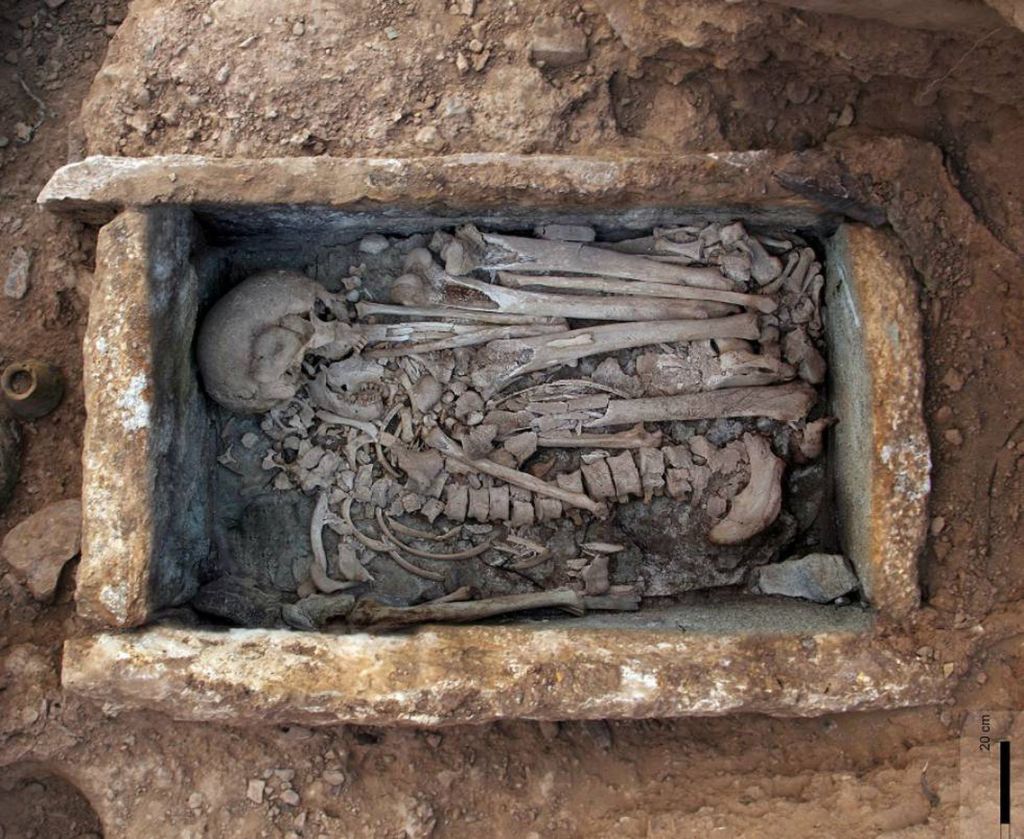
This image shows a bunch of broken and disfigured skeletal limbs and body parts of various men killed by the Yamnaya all dumped together into this open stone coffin in modern-day Spain without any proper respect. This goes to show just how brutal these Yamnaya people were.
There have actually been archaeological facial reconstruction of how these people looked and this is an example image of a facial reconstruction done from a Yamnaya fossil:
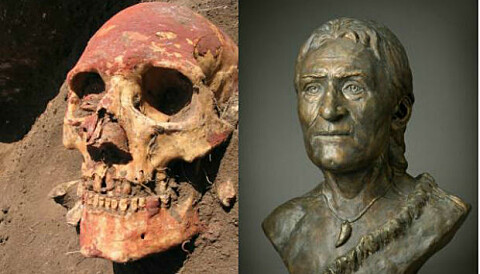
The facial reconstruction of how this Yamnaya man looked (right) is done by using his corpse (left). As you can see, this Yamnaya man has very European features, he looks tall, is muscular, and has a very European-looking face. Here are much more accurate facial reconstruction of some other Yamnaya men:

These are way more accurate facial reconstruction of Yamnaya men. The shocking and interesting thing here is that these people shown above do not even remotely look like Europeans. They look like Indians! These people clearly look like us Indians! Which means these Yamnaya people were Indians! In the Shrimad Bhagavata Puran, it says that when Parshuram was going around killing every single Kshatriya twenty-one times, many Kshatriyas fled from India to other parts of the world such as Europe. As we all know, Parshuram definitely existed way before 5000 years ago, but since he murdered all Kshatriyas 21 times, it takes an unimaginably long period of time, possibly millions, to live twenty lives, and if you add that to the amount of time a soul has to wait to rebirth (that too 21 times), it equals an unbelievably huge number of years. So it would make sense that this lasted until 5000 years before today.
Another theory is the battle of the ten kings. The battle of the ten kings is a famous Rigvedic battle in which the Bharatas, which is a Vedic tribe fought nine other tribes, each with their own king. The battle resulting in victory for the Bharatas and the other Vedic tribes had to leave India and they started to live elsewhere. In fact, in this battle, the Greeks were one of the tribes who fought in this battle, and after they lost, they fled to Greece and started their Hellenic civilisation in Greece. This could explain the similarities between the cultures of Hellenic mythology and Hinduism. Anyways, in this battle, the tribes that fled to Europe could have started their own civilisations there.
Another theory is that the Europeans were the people of Danu. Danu, along with Aditi was one of the wives of Rishi Kashyap. Like the sons of Aditi were the Adityas, the sons of Diti were called the Danavas, and the sons of Diti, another wife of Kashyap were called as Daityas. The Danavas and Daityas were against the Devas and Suras and they formed their own clan called the Asuras. In Europe, the ancient Irish people also worshipped a goddess named Danu and they also worshipped Tuatha de Danann (meaning people of Danu in old Irish), a clan of supernatural beings who they worshipped. These could be the Danavas of our Vedic culture. So, the Europeans could have been some Vedic tribes who were settled in other lands. Similar to the ancient Irish people, in Zoroastrianism, Asuras are worshipped. In Persian, Ahura is the word for God, and Daeva is the word for demon. Which means the Persians worshipped the Asuras as gods and thought of Devas as demons. Proof that Ahura is cognate with Asura is that in old Persian, a “s” sound was not pronounced and would turn into either “h” or “sh”. This is also happened, when the Persians called the Sindhu river as the “Hindu” river and based on that, they gave India the name of “Hind” or “Hindustan” and called the religion of the Indians as the “Hindu” religion. This word was taken by the Greeks and Romans and became “Indus”. Based upon that, they gave India the name of “India” or “Indiae” which was borrowed into virtually every European language. Coming back to the Zoroastrian people’s beliefs about Asuras, in fact, in the Vedas, also sometimes use “Asura” in the sense of a race equal to the Devas! In fact, the Asuras are not evil, as commonly believed, just because they are the enemies of the Devas does not mean they are evil. They, in fact are their own race, with their own civilisation and culture who are also worshipped by some religions.
That is it for this very long article in which I got rid of the misinformation I had given in the previous article about Manu and also gave some additional facts regarding him. Then I described the systematic distortion and subversion of our culture by Britishers and I explained why the Aryan Invasion Theory is senseless, and finally I explained the linguistic and cultural connections between Indians, Persians, and Europeans. By the way, the next article will be about quantum gravity and I hope you are excited about that one! Additionally, Abhijit Chavda is an amazing physicist and historian who gives wonderful information through his videos on YouTube. I recommend you check out his videos.
Sources:
Abhijit Chavda
Langfocus
English El Pais
Wikipedia
Oath of the Vayuputras (Final Book of Shiva Trilogy series)
Ram, Scion of Ikshavku (First Book of Ramchandra series)
Max Muller Quotations Source: Puneetchandra WordPress Blog
Image Sources:
Abhijit Chavda
ScienceNordic
i.ibb.co
 Random Thoughts